 Japan Reviewed
Here is the conclusion. If you are buying one set of bath towels, buy the Air&Thin two-pack.
Two reasons, and they both point at the same product. It is the only listing that prints an Imabari Towel brand certification number (2014-1281) — which means it is the only one you can hold up against the trade association's own records. And it is the only one whose Japanese counterpart we could identify, so it is the only one where you can read what actual owners say before you spend anything.
Which brings me to the thing this article is really about. The word "Certified" in an English listing title is a claim by the seller, and there is no way to check it. What you can check is a number — and the listing that prints the number is the one that does not say "Certified" in its title. The most obvious signal is the weakest one. Not one page on the English first results page draws this distinction.
Then, before you order, look at the size. A Japanese "bath towel" is smaller than a US bath towel. The two whose dimensions are stated measure 25.5 × 47.2 inches and 23.6 × 48.0 inches, against a US standard of 27 × 52 inches — four to five inches shorter in both cases. If you wrap a towel around yourself, that is a difference you discover after it arrives. No article on the English first page mentions it.
After size, what matters is understanding what the certification mark actually promises. The Imabari Towel Industrial Association's quality standard defines absorbency as sinking within 5 seconds under JIS L1907, and it requires the towel to pass that test twice — unwashed, and again after three washes. The mark certifies that the towel drinks water before you have broken it in. It does not certify fluffiness. If you came here for thickness and volume, this is the point to move your expectations.
Everything below comes from reading the Imabari Towel Industrial Association's own Japanese pages, the Japanese pages of towel makers in Imabari, and a pool of eight separate collections of Japanese customer reviews. Nobody here has held these towels.
Pick three

The only one you can check by number
Imabari Towel Air&Thin Quick-Dry Bath Towel, 2-pack
Sold in Japan as hiorie's "Imabari Reverse Towel". The only listing that prints certification number 2014-1281, and the only one whose Japanese counterpart we could identify. 265g, thin and quick-drying — the first choice if you dry laundry indoors.
If you want to decide from the title alone
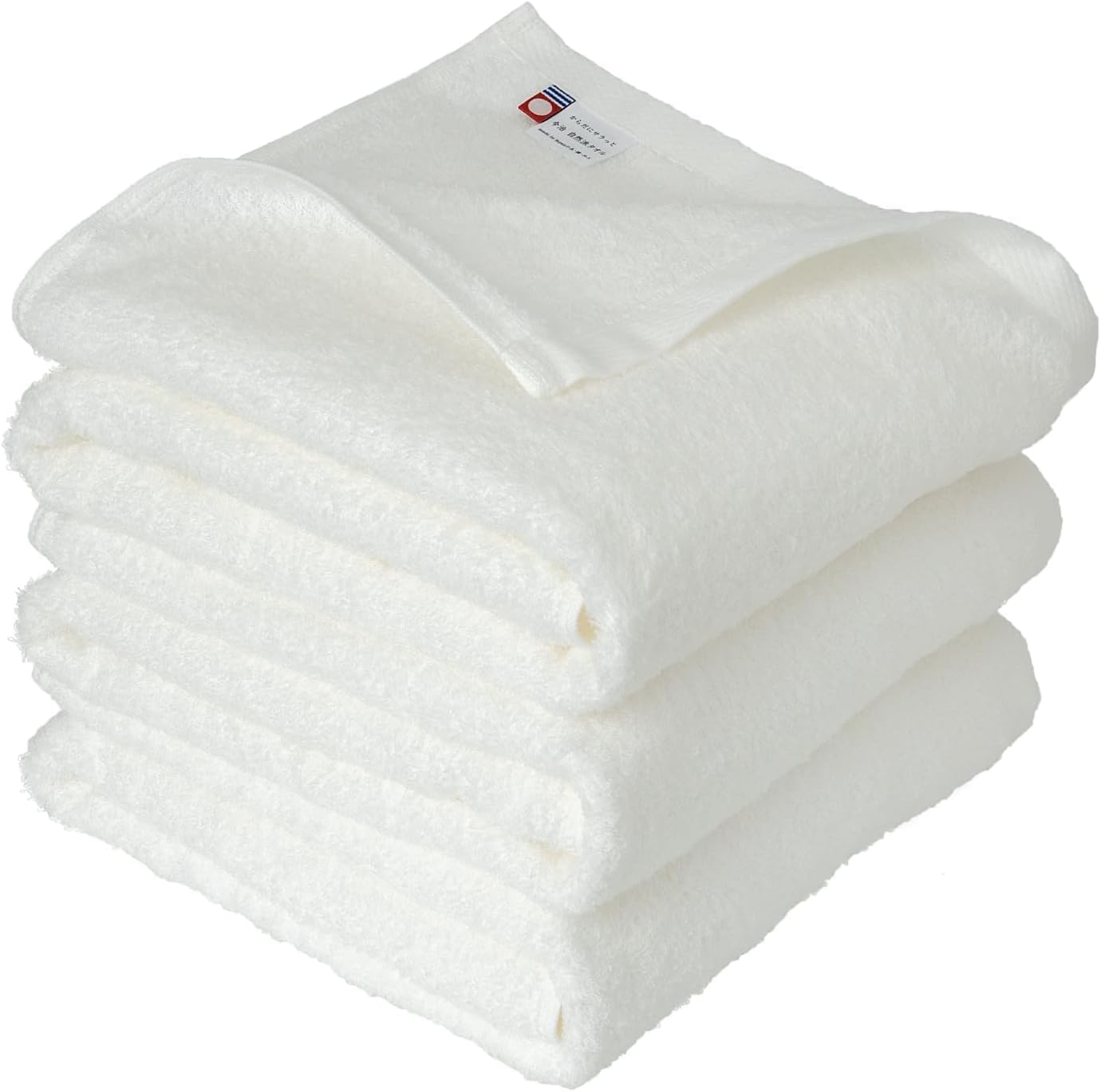
Imabari Towel Certified Natural Bath Towel, 3-pack
Title carries both "Certified" and the dimensions, and the bullets state plainly that it is a thin towel using 40-count fine yarn. But there is no certification number and no identifiable maker. Three towels means your spares arrive at the same time.

For replacing the towels by the sink
hiorie Imabari Border Face Towels, 4-pack
Title includes "Imabari towel certification". Same hiorie manufacture as the Air&Thin, so the thin-and-quick-drying findings carry across. Four towels — the unit for swapping out a bathroom sink's worth at once.
All three show certification somewhere on the listing page.
And do not judge them the moment you open the box. Towels shipped by mail are compressed for transit. "It was as thin as cardboard coming out of the mailbox — I thought it was a flyer," and "after one wash it was a normal thickness," are buyers' own words, and they explain a slice of the bad reviews. Treat one wash and dry as part of unboxing. The specific claim that volume roughly doubles comes from a single personal blog, and we found nothing further to support it.
Wash the first few loads on their own, in a mesh bag, without fabric softener. The reason is further down.
What you are buying is a thin towel — and that is fine
Japanese reviews split thick and thin cleanly, and the association's own shop lists the types by use rather than by rank. Only two axes actually reverse: thick absorbs better, thin sheds less.
All three picks here sit on the thin side. Among Imabari towels on Amazon.com, no listing that we could confirm as certified is described as thick. So the stars below sit on the thin-and-quick-drying type — the type the three recommendations actually belong to. They are per type rather than per listing because the review pools we found exist per type; splitting them across individual listings would be inventing numbers.
Thin and quick-drying (where all three picks sit)
Absorbency sits half a step lower not because anyone objected. All three pools we drew on were positive; what differs is the register — it is described as sufficiency, "thin but plenty," rather than as reserve. The highest score goes to stiffening after washing, unanimous across four pools: "no matter how many times I wash it, it never goes scratchy." It is not 5.0 because the largest pool's overall tendency is qualified as "on the soft side (not fluffy)" — so if you are buying for fluffy, this is where you land half a step off.
These three numbers apply only to thin pile and sheared weaves. Waffle weave produces findings that point elsewhere — "harder than I expected," "loses its shape," "catches on your nails." Waffle is easy to end up with when searching for thin and quick-drying, so check the weave on the product page first.
Thick and plush — as a place to put your expectations
No stars, because there is nothing to buy. It is here anyway so that anyone who arrived picturing a hotel towel knows what they are giving up.
Thick absorbency rates highly across three pools, and the register has reserve in it — "even after washing, the absorbency is the same as new," "dried off in one pass." One eight-review pool does still contain "if you are picturing a hotel towel, the absorbency is a bit disappointing." And you pay for it in shedding. Early lint is the single biggest complaint in all three pools, with one-star reviews reading "the fibre dust at the start is unbelievable — it took five washes to settle." Even if you could buy thick, the first few weeks cost you more work than thin.
Imabari Towel Air&Thin Quick-Dry Bath Towel, 2-pack
The only listing with a certification number, and the only one with readable Japanese reviews behind it. Two separate reasons landing on the same product is what settles this article.
The bullet list reads: "When you see the Imabari logo, you can be sure of superior water absorbency as well as durability. (Imabari Towel Approved certification number: 2014-1281)". That number matches the format used in the association's own product database — a certification number YYYY-NNNN plus a separate four-digit company number. The leading four digits are the year of certification, so this one was certified in 2014. Printing the number is a claim that a matching registration exists on the association's side, and that is a step up from the word "Certified."
In Japan it is sold as hiorie's "Imabari Reverse Towel," where the listing title does carry the word for certified. Each towel is 60 × 122 cm and 265g, thin and quick-drying. What Japanese reviews keep returning to is the drying speed: "dries fast — a real blessing in the rainy season and in winter," "looks like it would dry quickly even indoors on a hanger." A towel for a household that dries laundry indoors — which lines up with the association's own shop describing thin towels as "light, quick to dry, and compact when folded." Japanese reviews of thick towels include "the trouble is it dries slowly after washing when it's cold," which is the same point inverted.
And note that the Amazon.com title does not contain the word "Certified." The same product says certified in Japan and does not in its US title. Judge certification by the English title alone and you skip past the best-evidenced towel here.
One practical warning. The same range carries other colours, a 3-pack of hand towels and 2-packs of bath towels in other colours. The bullet list even contradicts itself, saying "3 pieces Bath towel set" on one line and "Each set includes 2 Bath Towels" on another; the title says two. Everything looks nearly identical while the count and the item type change, so check for "bath towel" and "2-pack" before it goes in the cart.
What works
- Certification number 2014-1281 is printed in the listing. The only one here that can be matched against the association's record format
- The only product whose Japanese reviews are readable, so the behaviour of thin pile is knowable in advance
- Reviews on the seller's own site agree shedding is "almost none" — a lighter start than thick towels
What to know first
- No certification wording in the English listing title (the Japanese listing has it)
- At 23.6in wide it is 3.4in narrower than the US standard. Small if you wrap it around yourself
- The bullets contradict themselves on the count — "3 pieces" versus "2 Bath Towels" — and colour and item variants sit in the same range
Best for
- Anyone who wants to check certification by number before buying
- Anyone drying laundry indoors, where drying speed is the priority
Not ideal if
- Anyone who needs a towel big enough to wrap around themselves
- Anyone after a thick, plush hand-feel
Start with the lavender two-pack. Mist Blue differs only in colour, so take your pick.
See the Air&Thin two-pack on Amazon
Lavender, 2-pack. Mist Blue is B085DRXQ61 and differs only in colour. Certification number 2014-1281 appears in the listing bullets.Imabari Towel Certified Natural Bath Towel, 3-pack
If you want to decide from the title, this is the one. "From the title" is also this listing's ceiling.
The title runs "Imabari Towel Certified Natural Bath Towel 3 Sheets 100% Cotton Made in Japan 25.5 x 47.2 inches White…". 100% cotton, three towels, roughly 65 × 120 cm. The bullets state outright that it is a thin towel using 40-count fine yarn — "a thin towel for everyday use that is easy to fit on the body and uses thin threads of 40th count" — at 8.11oz each. It is actually the only listing here whose thickness you can read off the page.
Here is where the Japanese material earns its keep. "Made in Imabari" and "Imabari Towel brand certified" are different things. The association states plainly that not every towel manufactured in Imabari becomes an Imabari Towel brand product. A name tag saying "Imabari Towel" is not certification; the brand mark is. And "Imabari Towel" is a registered regional collective trademark (6 July 2007, registration no. 5060813), so non-members cannot even use lookalike phrasing such as "Imabari-made towel" — which means the "Imabari" in a listing title is not a word a seller can attach for no reason.
The weakness follows directly from that. This listing prints no certification number anywhere. We checked the whole page: there is no entry corresponding to a certification number, and the brand is the generic "Imabari Towel," so which member company made it cannot be identified. The "Certified" in the title is the seller's own assertion, and no means of verifying it has been provided to the reader. That is the gap between this and the Air&Thin above.
What works
- Certification wording and dimensions are both in the title, readable without opening the page
- Bullets state 40-count thin yarn. The only listing whose thickness is knowable in advance
- Three towels, so spares are covered in one purchase
What to know first
- No certification number, so the reader has no way to verify "Certified"
- Generic brand name, and the manufacturing member company cannot be identified
- 25.5 × 47.2in is smaller than the US standard — about 5in shorter
Best for
- Anyone who wants to choose quickly from the listing title
- Anyone who wants three bath towels at once
Not ideal if
- Anyone who wants to trace certification back to a number
- Anyone expecting US standard sizing
Three towels is the standard configuration and the colour is white. We could not confirm a single-towel option.
See the three-pack with certification in the title on Amazon
White, 3-pack. Dimensions and the 40-count thin yarn are as stated on the listing. No certification number or maker is given on the page.hiorie Imabari Border Face Towels, 4-pack
Nobody replaces the towels by the sink one at a time. This is the listing for doing all four at once.
The title includes "Imabari towel certification". It is a thin, long-pile towel in fine combed yarn, sold on quick drying. Same hiorie manufacture as the Air&Thin, so the thin-and-quick-drying findings above — does not go scratchy, sheds lightly, absorbency at the level of "plenty" — carry across. A standard Japanese face towel runs 30–35 × 80–90 cm, longer than a US hand towel. Plenty for drying your face, not enough for drying yourself.
That said, this listing's description contains no product-specific information at all. The bullets are boilerplate — "Imabari Towel is a traditional craft made in Japan for over 100 years," "It is the most popular towel in Japan," "It is also popular as a souvenir" — with no dimensions, no certification number and no breakdown of the set. The bullets are word-for-word identical to another product from the same seller (the hedgehog set below), which confirms they are not written per product. The certification wording in the title may be genuine, but the page itself adds nothing — this is where you get stuck if you try to verify certification yourself.
What works
- Certification wording in the title
- Thin, long pile, with Japanese reviews supporting the quick drying
- Four towels — the right count for rotating a bathroom's face towels
What to know first
- No dimensions given on the product page
- Bullets are boilerplate and identical to another product from the same seller. No certification number either
- It is thin, so expecting volume will disappoint
Best for
- Anyone replacing the towels by the sink in one go
- Anyone who takes drying speed over thickness
Not ideal if
- Anyone who wants dimensions confirmed before buying
- Anyone whose goal is a thick hand-feel
The colour is a mist border, grey and blue. Four face towels is the unit; bath towels are a separate range.
See the hiorie four-pack of face towels on Amazon
Face towels, 4-pack. Dimensions could not be confirmed from the product page.Two that turn up in the same results without enough information
Neither can go in a recommended slot, but you will meet them in the same search, so here is how to treat them.
The hedgehog-print three-pack is face towels, not bath towels. The Amazon.com title mentions neither dimensions nor certification, but the same ASIN on Amazon.de is titled as a set of three face towels at 34 × 80 cm. Choose it for the print and you will get the size wrong.
The triple-gauze organic cotton single towel has neither dimensions nor certification wording we could confirm. The product page's bullet list is a single line reading Gauze,cotton,organic Cotton,silk and nothing else. That is a statement about this one listing rather than about gauze towels generally, but until it can be confirmed it does not go in this article's certified column.
How to check certification yourself
The association runs a public database of certified products. The Imabari Towel Industrial Association's product search at itia.or.jp/towel_db holds 17,652 registrations and anyone can query it. No article on the English first page points readers to it.
A registration record looks like this:
- Certification number —
2026-1697, in the formyear-serial. The leading four digits are the year it was certified - Certification date
- Company number — four digits, such as
0315. This is the number tied to the manufacturer, and it is the one printed on the back of the certification mark
One thing to correct, because Japanese explainers get it wrong. Several Japanese articles tell you to type the four-digit company number into a search box to identify the maker. That does not match the page as it stands. The filters actually provided are manufacturer name, item type, certification date and dimensions — there is no field for entering a number. The realistic method is not reverse lookup but narrowing by maker, item and size and seeing whether a matching registration exists.
So what a printed certification number buys you is verification, not search. It still matters: printing a number asserts that a corresponding registration exists on the association's side, and a listing without one is not even making that claim. That difference is why the Air&Thin is ranked first.
Looking after them
Avoiding fabric softener is advice the English articles already give. What only the Japanese sources supply is the reason. Fujitaka Towel, a maker in Imabari, explains that softener does not merely impede absorbency — it makes the fibres slip so the pile pulls out. It is the same story as shedding: softener is on the causing side of the problem.
- Water volume matters most. Wash with "enough water that the towel really moves around in it"
- Wash on their own for the first few loads. Japanese reviews converge on three to ten washes before shedding settles, and worse for thick towels. Washing new towels with the family's laundry deposits lint on your clothes — a warning absent from the English coverage
- Use a mesh laundry bag. Do not overfill it
- Snap them out before hanging, and dry in ventilated shade. Direct sun stiffens the fibres
- If a pile loop pulls out, do not tug it — cut it at the base with scissors
Tumble drying needs an explanation neither language's articles give. The association's quality standard adds, in the notes to its washing test, that the towel is "tumble dried after three washes" — meaning the certification test puts the towel through a dryer and then re-confirms the 5-second rule. Meanwhile the retailer Imabari Kinsei — which is the gift arm of STYLEM Ltd. rather than a maker in the region — advises that "using a dryer causes damage to the fabric." These do not contradict each other. Certification guarantees that absorbency survives a dryer; it does not recommend one.
So which one
- You want to verify certification by number, and you dry laundry indoors → Air&Thin. The only listing printing a certification number, and the only one whose Japanese counterpart we could identify
- You want to choose quickly from the title, and you want three → the certified three-pack. But "Certified" there is the seller's own word, with no number behind it
- You want to replace the towels by the sink → hiorie's four-pack of face towels
- You want to check certification yourself → how to check certification yourself. What the association's database can and cannot do
- You want the print, or you prefer gauze → the two without enough information. Confirm it yourself before buying
- You want a hotel towel → decide where to put your expectations first. What certification guarantees is speed of absorption, not thickness and volume. What is certain is that the sizes run smaller than the US standard
And choose pile or sheared weave. Waffle, easy to land on when hunting for thin and quick-drying, is discussed in Japanese reviews as a different thing entirely.