 Japan Reviewed
Here is the short answer. If you are only reading one, read Delicious in Dungeon. Fourteen volumes, finished, and the English edition runs to volume fourteen as well. If you actually cook, read What Did You Eat Yesterday?. If you want one large thing to sink into, Food Wars! is thirty-six volumes and it finishes in English too.
And here is the thing this article most wants to tell you. If you buy Oishinbo in English, you do not get the story. The English release, Oishinbo à la Carte, is seven volumes. The Japanese original runs to 111, and its spine is a son and the father he has cut himself off from — but the English edition is a thematic selection of the food chapters, and the man at the centre of that conflict does not appear at all in the last English volume. Pages that list this series with "Volumes: 111" and no mention of the English release are still on the first page of search results.
So the first thing I checked for every book here was not whether it is good. It was how far you can read it in English. I went back through the English "best food manga" roundups on 21 August 2026 and read the five I could get the full text of. Not one says where the English edition of anything on its list stops. Three of them recommend The Drops of God without mentioning the fact a buyer needs: in print it breaks off partway, and the only way to read all forty-four volumes in English is digital.
Who this is not for
- Anyone who wants what is airing right now. Everything here has years of Japanese reviews behind it.
- Anyone looking for a cookbook. Exactly one of the seven gives you quantities you could cook from. The rest make you hungry, which is a different product.
- Anyone who wants everything on paper. For one of these seven, reading the whole thing in English means reading it digitally. I say so in that entry.
- Anyone collecting the Japanese editions. This is only about what you can read in English.
The three things I judged on
1. How far the English edition goes. Finished, ongoing, or a selection — that comes before whether it is any good.
2. Enough Japanese reviews to say anything with. At least two independent Japanese sources per title, four for some, read for what they agree on and where they contradict each other.
3. Something particular about how it draws food. "It makes you hungry" is true of most of the genre. I wanted seven books that do it for seven different reasons.
The short list

Best overall — start here
Delicious in Dungeon
A party out of money and out of food goes back into the dungeon, cooking the monsters as they go. Japanese reviews land on the same odd verdict: the ingredients do not exist and you get hungry anyway. The best-regarded ending of the seven.

If you want one long one
Food Wars!
A diner cook's son is dropped into an elite culinary school built around cooking duels. The art is not in question. The late volumes divide Japanese readers, and it is worth knowing that before volume one.
For people who actually cook
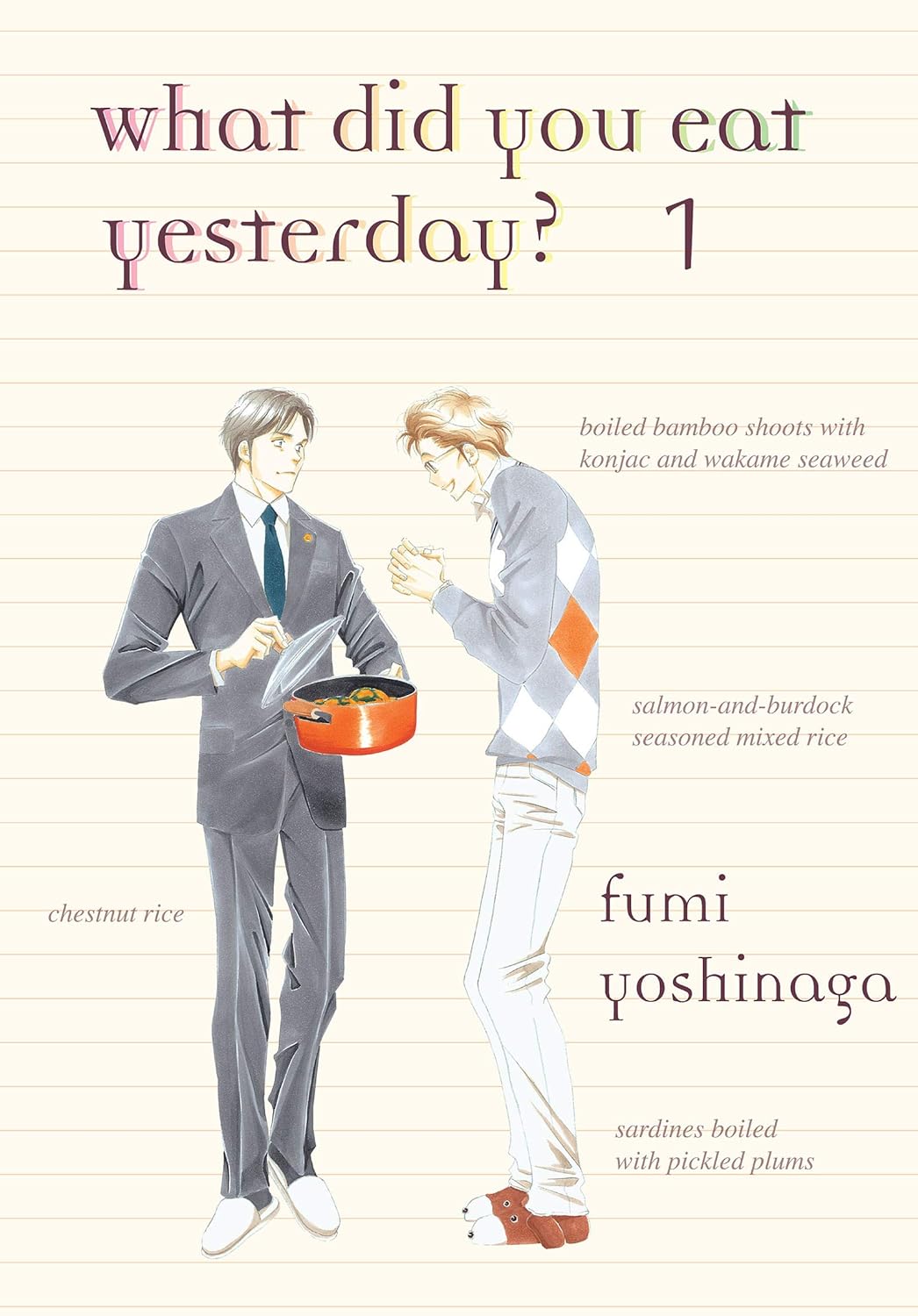
What Did You Eat Yesterday?
A lawyer and a hairdresser run their life together one dinner at a time. In Japan it is read as a recipe book — readers have built indexes of every dish by volume.

Short, gentle, and it ends well
Sweetness and Lightning
A widowed father who cannot cook, a schoolgirl who cannot cook, and a five-year-old. Three people who had been eating alone start eating together. Twelve volumes — the easiest here to plan a finish for.

The food manga you drink
The Drops of God
A father's will sets one condition: identify twelve wines. Japanese reviews are full of readers who went out and bought a bottle because of it.

A giant — but a different book in English
Oishinbo
135 million copies in circulation. What you can buy in English is seven themed volumes of the food writing. The story the original is built on is not in them.

Buy it for the first half
Yakitate!! Japan
A boy sets out to invent a bread Japan can call its own. The baking chapters are well liked; three independent Japanese sources mark it down for where it goes afterwards.
The star ratings below summarise what Japanese review aggregators and personal review sites agree on — two to four independent sources per title — and every axis label says so. What I say about the English editions is only how many volumes there are and what is inside them.
Delicious in Dungeon
Food that does not exist, cooked in a way that makes you hungry. Of these seven, this is the only one where that happens.
The party is beaten by a red dragon and Laios loses his sister Falin. To get her back he turns straight round and goes down again with Marcille the mage and Chilchuck the lockpick, with no equipment and no provisions left, so he makes a decision: they will eat the dungeon as they descend. A rescue with a clock running on it, one monster cooked per chapter laid over the top — not the leisurely gourmet series the premise suggests. It ran in Harta from February 2014 to September 2023 and finished at 97 chapters, fourteen volumes, with over 14 million copies in circulation as of March 2024 and first place in Kono Manga ga Sugoi! 2016.
Reading the Japanese reviews, one verdict turns up for this book and no other: you could not actually make any of it, and it still feels like you could if you had the ingredients. The reviews on Comic Cmoa say why — the anatomy and ecology of each monster is what the cooking method is reasoned from, so the steps hold together in your head. English coverage stops at "monster cooking" as a fun idea and never gets to why it makes you hungry. That is a large part of why it is first here.
The ending is also the best regarded of the seven. Three independent Japanese sources agree that it closes without being padded out. Some readers found the middle stretch slow, but the complaint is noticeably milder than what the other six attract.
What works
Finished at 14 volumes, and the English edition runs to all 14 — it does not stop partwayFirst place, Kono Manga ga Sugoi! 2016Three independent Japanese sources agree the ending is strongYou do not have to cook to enjoy it — nothing in it is cookable anywayWhat to know first
Useless as a recipe source. Nobody sells monsterMore than one review says the early volumes were the most fun, and that the food recedes as the story gets heavierIt asks you to take on a full fantasy setting. This is not light readingBest for
Anyone who likes food manga and fantasy equally. Anyone who wants one finished series at a manageable 14 volumes. Anyone who never cooksNot ideal if
Anyone who wants recipes they can use. Anyone who wants the food to stay in the foreground all the way throughThe English edition is Yen Press's. Try volume 1 and, if it lands, you can go straight through to fourteen. There is also an official complete box set if you already know you are in.
See volume 1 on Amazon
Volume 1 in English. Yen Press's official edition, complete to volume 14.Food Wars!
The one that hits you with the drawing. Thirty-six volumes is a lot of book — but you can read every one of them in English.
Sōma Yukihira has worked his family's diner counter since he was three, and wants to beat his father at it. When his father shuts the place up and goes abroad, Sōma is packed off to Tōtsuki, an elite culinary academy where students settle things through shokugeki — cooking duels, which is where the Japanese title comes from. What you should walk in expecting is a shonen tournament series with cooking in the place where the fighting usually goes. It ran to 315 chapters and thirty-six volumes, and VIZ has published all thirty-six in English.
Japanese reviews agree on the art. The 1,449 reviews on Mechacomic average 4.1 and keep saying two things: it is beautifully drawn, and the dishes make you want to try them. The food researcher Yuki Morisaki is credited for culinary assistance, which is on the English covers too. What is only on the Japanese side is what follows from it — Shueisha published a separate official recipe book and states plainly that Morisaki devised every recipe in it. The series itself is not a recipe source, and it is better to know that before you go looking for quantities.
Then the late volumes, which I will be straight about. Four independent Japanese sources record that opinion splits over roughly the last five or six volumes' worth of story. In the same places you find the defence — that the setup was there all along, and that it resolves acceptably in the collected edition. So "Japan considers it a failure" is not true; what is true is that Japan splits on the ending, and that is worth knowing before you commit to thirty-six volumes.
One more thing divides people cleanly. The way tasting is drawn — as an enormous physical reaction — gets criticised as a poor fit for food and defended as a joke about how good food feels, often in the same review column. That style has a lineage here, and Yakitate!! Japan is its ancestor.
What works
Finished at 36 volumes, and all 36 are out in EnglishJapanese reviews agree the food art is the strongest of the sevenA working food researcher is credited for the cookingWhat to know first
Four independent Japanese sources record a split over the late volumesThe series itself is not a recipe source — in Japan the recipes are a separate bookThe exaggerated tasting reactions are firmly a matter of tasteBest for
Anyone who wants food at shonen volume. Anyone who welcomes 36 volumes. Anyone who reads for the contestNot ideal if
Anyone after something quiet. Anyone who cannot forgive a weak final stretch. Anyone put off by sexualised reaction gagsThe English edition is VIZ's, under Shonen Jump. Start with volume 1.
See volume 1 on Amazon
Volume 1 in English. VIZ's official edition, complete to volume 36.What Did You Eat Yesterday?
English write-ups stop at "a middle-aged gay couple's daily life". In Japan this is sold as a book about household budgets.
Shirō Kakei is a salaried lawyer at a small neighbourhood practice; Kenji Yabuki is a hairdresser. They live in a two-bedroom flat and call each other Shiro-san and Kenji. And the publisher's own blurb leads with a number. Kodansha's official page for the series opens by stating the household's monthly food budget, and the volume summaries give Shiro-san a personal target for keeping it under. I do not know another cooking manga whose sales copy contains a figure. This is not filed as "slice of life"; it is sold, explicitly, as a book about money.
Japanese reviews pick up the motive. Thrift undertaken out of worry about old age, and balanced menus kept up to stay healthy — read on the understanding that a same-sex couple has thinner legal protection to fall back on. Work relationships and the distance between the couple and their families come up just as consistently, and readers call that material startlingly true. On the couple itself, the dominant note is that the care they show each other reads as care regardless of gender, and reviews that go on to talk about marriage equality are not rare. Criticism is close to absent — one- and two-star reviews are 2% of the total on Mechacomic. A better English summary would be: two men budget their way through work, family and getting older, one dinner at a time.
On usefulness it is untouchable here. There are several fan-built indexes of every recipe by volume, and blogs where someone has cooked their way through; I searched in Japanese for this article and found five of them. Comic Cmoa's 1,119 reviews (averaging 4.6) and Mechacomic's 3,738 (averaging 4.5) are full of "I actually made this" and "nothing fancy, and the quantities are easy to follow".
The hunger it produces is a different species, too. Three independent sources describe reading it late at night and regretting it, and what they praise is how good ordinary home cooking looks — the recurring phrase is about the cleverness of throwing together whatever was on offer at the supermarket. Where Food Wars! overwhelms you with drawing, this makes you hungry within range of what you could put on your own stove tonight.
This is the only entry with no "holds up to the end" score. It is still running, so there is no end to hold up. Scoring it on the same axis as the other six would be making something up.
What works
The most genuinely useful of the seven. Quantities are given, and people in Japan cook from itComic Cmoa 4.6 across 1,119 reviews and Mechacomic 4.5 across 3,738 — the strongest numbers here, on the largest samplesReads as the practical business of living: food costs, saving for old age, familyClose to episodic, so 23 volumes is not the barrier it sounds likeWhat to know first
Still running, and the English edition has not caught up with the Japanese, so you cannot plan to finish itThere is no contest and no crescendo. It proceeds quietlyBest for
Anyone who cooks. Anyone who likes a quiet everyday story. Anyone comfortable following something unfinishedNot ideal if
Anyone who only reads completed series. Anyone who wants big momentsThe English edition is Kodansha's. Start with volume 1; the English release reaches volume 23, and the Japanese original is still going, so at that point you wait like everyone else.
See volume 1 on Amazon
Volume 1 in English. Kodansha's edition runs to volume 23 so far; the series is ongoing.Sweetness and Lightning
"A gentle story about a father and daughter" covers about half of it. This is a book about two adults who cannot cook.
Kōhei Inuzuka teaches high-school maths, has lost his wife, and is raising five-year-old Tsumugi alone. He cannot cook, eats little, and has no palate. Then Kotori Iida, one of his students, joins them and the three start cooking and eating together — and Kotori is missing the same thing he is, from the other direction. Her mother is a food writer whose work keeps her away, so Kotori, living above her mother's restaurant, eats alone as a matter of routine; an old injury means she cannot use a knife either. She has the knowledge and the palate and cannot cook.
So the book is two people eating alone for different reasons, building a table around a child. Kodansha's tagline calls it a delicious triangular family drama, and that is who the triangle is. It ran in good! Afternoon from March 2013 to September 2018 and finished at twelve volumes including the extras, passing 3 million copies and placing eighth in Kono Manga ga Sugoi! 2014. Kodansha Comics has published all twelve in English, the last in June 2019.
Japanese reviews agree on two things. The first is comfort — warmth, kindness to the stomach and to the reader, repeated across Mechacomic (4.4 over 573 reviews) and Comic Cmoa (4.4 over 327). The second is probably absent from every English page about it: parenthood. Readers describe it as something to re-read as a father raising a daughter, and as a book that made them reconsider how they feed their own family. The cooking is reproducible, too — both sites agree it makes you want to cook. It is not indexed the way What Did You Eat Yesterday? is, but as a book of food you could actually make it is the runner-up here.
Three independent sources also agree on the ending. They call it a good close, quiet but with a strong aftertaste, and not one complains that it was dragged out — the word that recurs is concentrated. It sits at the opposite end of this list from Food Wars! and Yakitate!! Japan. There is one reservation, raised by several reviews: a relationship is left open rather than settled, and readers divide over whether that is unsatisfying or the point. The twelfth volume also carries extra chapters, which the same three sources think well of.
What works
Finished at 12 volumes, complete in English, and the shortest read hereThree independent Japanese sources agree it ends without being paddedThe cooking is reproducible — food you could actually makeEighth place, Kono Manga ga Sugoi! 2014What to know first
There is no edge to it. Gentle, and it stays gentleOne relationship is left open at the end, and some readers want it settledBest for
Anyone who wants something short and finished. Anyone raising a child. Anyone who wants to cook what they readNot ideal if
Anyone who wants tension or competition. Anyone who wants to sink into something long. Anyone who needs everything resolvedThe English edition is Kodansha Comics'. All twelve volumes are out, so a plan to finish it is an easy plan to make.
See volume 1 on Amazon
Volume 1 in English. Kodansha Comics' official edition, complete at 12 volumes.The Drops of God
All forty-four volumes have only been readable in English fairly recently — and only digitally.
Yutaka Kanzaki, a wine critic of international standing, dies and leaves an enormous cellar behind him. The will sets a condition: name the producer and vintage of twelve wines — the "Twelve Apostles" — and of the one above them all, the Drops of God. Whoever does that inherits. His son Shizuku, who has spent his life rejecting his father's education and works for a beer company, is the obvious heir; against him stands Issei Tomine, a young critic called the prince of the wine world, whom Yutaka adopted shortly before his death. An inheritance turned into a contest, with a wine explained in detail at every stage. It ran in Morning and finished at forty-four volumes.
What happened to this series in English is the reason this article exists. Vertical began publishing it in 2011 in omnibus volumes of two Japanese volumes each — and stopped after five books, in 2013. Worse, that fifth book covers Japanese volumes 22 and 23, so thirteen volumes' worth of story in the middle was skipped over. Then, between 2019 and 2021, comiXology Originals and Kodansha released the whole run digitally, and all forty-four volumes existed in English for the first time. In print, they still do not. Three of the English roundups recommending this book say none of that. A reader who starts buying it on paper walks into a dead end.
Japanese praise lands on two points. You learn something real — Mechacomic (4.1 over 277 reviews) credits it with making French wine legible down to grape varieties and producers, and one writer on note says it takes in someone who knows nothing about wine without effort. And the technique: rendering a taste as a scene rather than as vocabulary is treated as this series' invention. Readers act on it, too — Japanese reviews are full of people who went and bought a bottle, to the point that wines appearing in it are noted as having become harder to get. The criticism is that the coincidences are convenient and that the later stretch slackens.
There is no "could you cook it at home" score here. You do not make any of this, you buy it and drink it, so the axis the other entries share does not apply.
What works
Finished at 44 volumes, and all 44 are readable in EnglishTwo independent Japanese sources agree you come away with usable knowledge about wineThe way taste is rendered as a scene is credited to this series as its own inventionWhat to know first
English is digital only. The print run broke off partway and skipped thirteen volumes' worth of story in the middleConvenient coincidences are a recurring complaint, and Japanese reviews say the later stretch slackensForty-four volumes is longBest for
Anyone who would rather drink than eat. Anyone who wants a book to teach them something as it goes. Anyone happy reading digitallyNot ideal if
Anyone who collects on paper. Anyone who wants a short read. Anyone who came to this list for foodThe English edition is Kodansha and comiXology Originals'. Start with volume 1.
See volume 1 on Amazon
Volume 1 in English. Complete to volume 44 in English, digitally — the print run never went that far.Oishinbo
What made it into English is the food writing. The story did not.
Shirō Yamaoka, a journalist on the arts desk of the Tōzai News, is assigned with his colleague Yūko Kurita to the paper's centenary project: the Ultimate Menu. He is idle and tactless, with an exceptional palate and an enormous knowledge of food, and the problems people bring him get solved through what is on the plate. And that is not what the series is built on. Yamaoka is the son of Yūzan Kaibara, the gourmet presiding over a rival culinary society; they are estranged over the death of Yamaoka's mother, and Yamaoka has taken a different surname. A rival paper eventually installs Kaibara behind a Supreme Menu, and Ultimate against Supreme — father against son — becomes the long spine of the series.
It began in Big Comic Spirits in 1983, reached 111 volumes, and has been on hiatus since May 2014. Circulation is 135 million and it has a Shogakukan Manga Award. On the numbers alone it is in a different category from everything else here.
So what can you read in English? VIZ's Oishinbo à la Carte is seven volumes, published between January 2009 and January 2010: Japanese Cuisine, Sake, Ramen & Gyoza, Fish Sushi & Sashimi, Vegetables, The Joy of Rice, and Izakaya. Each gathers the chapters relevant to its theme — VIZ describes it as selecting from a hundred-plus-volume series into seven à la carte editions. It is thematic, not chronological, and it is not the 111-volume story read through.
And that costs an English reader something specific. Almost none of the Ultimate-against-Supreme material survives into those seven books. English reviews say so: the review of volume seven notes that, although this is the last English volume, Kaibara does not appear in it at all, and wishes for one more encounter between the two men. The review of volume one notes that time jumps around inside a single book and that the relationships have to be filled in from the endnotes. If what you want is Yamaoka and his father, you cannot read it in English. In fairness, English reviewers split — another treats the seven as a best-of by theme and reports not feeling lost. As a guide to the food it works; as a story it comes up short.
VIZ is not hiding anything; its press material calls the original a hundred-plus-volume series. But the same release calls volume seven "the final volume", and that phrasing stuck with me — to someone reading only English it sounds like the series concluded. And the Japanese bibliography shows the selection goes one layer deeper: Shogakukan published a fifty-volume thematic re-edit inside Japan, also called Oishinbo à la Carte, and VIZ's seven are a part of that. So what an English reader can hold is 111 volumes, re-cut into 50, of which 7 crossed over. None of the five English pages I could read mentions the fifty-volume series at all.
As a book, three Japanese reviews agree on the density of the writing: a great deal of text, remarkable research, food knowledge worth having. Comic Cmoa averages 4.0 over 54 reviews. The same three agree that the early volumes are the best, with the explanation crowding out the momentum later, and readers split over whether the protagonist's forcefulness reads as conviction or as lecturing. It is not usable as a recipe source — the typical verdict is that it rarely gives quantities but does show you the process.
These scores come from Japanese readers reading all 111 volumes in serialisation order. The seven English books are a thematic best-of and are not read that way at all. For someone buying in English the problem is not the slackening — it is that the story is mostly not there.
What works
135 million copies in circulation, and a Shogakukan Manga AwardThree Japanese reviews agree the density of food knowledge is in a class of its own hereThe seven English books are thematic, so you can buy only the subject you care aboutWhat to know first
You cannot read it to the end in English. Nothing comes after volume sevenThe father-and-son story the original is built on barely survives into the English sevenThematic and non-chronological, so relationships have to be filled in from the endnotesNot usable as a recipe sourceA steady share of readers find the protagonist's insistence preachyBest for
Anyone who wants a guide to Japanese food culture. Anyone happy to buy a themed anthology one book at a timeNot ideal if
Anyone who wants a story read straight through. Anyone who wants something that finishes. Anyone who thinks they are buying 111 volumes in EnglishIf you do buy it, choose by subject. The seven are self-contained themes, so there is no need to start at volume one — sake, or ramen and gyoza, are perfectly good ways in. The link below is volume one, Japanese Cuisine.
See volume 1 on Amazon
Volume 1, Japanese Cuisine, in English. The English release is a seven-volume thematic selection; the rest of the 111 volumes is not coming.Yakitate!! Japan
Nothing is wrong with getting hold of it. What is wrong is that Japanese readers got off partway.
At six, Kazuma Azuma meets the man who runs the local bakery and comes away with an ambition: to make a bread Japan can put its name to — "Ja-pan". Ten years later he presents himself at Pantasia, the country's grandest bakery chain, to go looking for it. It ran in Weekly Shonen Sunday from 2001 to 2007 and finished at twenty-six volumes. VIZ has published all twenty-six in English — the last one is even titled as the final volume. On this article's first criterion, it is the least obstructed book of the seven.
The early volumes are well regarded. What comes up again and again on Mechacomic (3.8 over 326 reviews) is how interesting the bread-making is: real depth in something you thought was simple. This is also the series that made the enormous tasting reaction a fixture — Japanese reviews trace the lineage by naming the cooking manga before it, and it is where Food Wars! inherited it from.
And then three independent Japanese sources agree that it loses them partway through. The complaint is consistent: it changed direction, moved from bread into comedy and parody, and they stopped reading. The way it finishes is notorious in Japan, and not in a good way — of these seven it has the weakest ending by some distance. So, plainly: buying it as a bread manga and reading the first half is the way to be least disappointed.
There is only one axis here. Three independent Japanese sources agree about the ending, so I can put a number on it with confidence, but for "makes you hungry" and "could you cook it at home" I could not assemble Japanese sources to the standard the other six met. Better an empty axis than an invented one.
What works
Finished at 26 volumes, and all 26 are out in EnglishJapanese reviews agree the early bread-making chapters are genuinely interestingThe clearest view on this list of where the food manga reaction gag comes fromWhat to know first
Three independent Japanese sources agree the change of direction partway loses readersIts ending is notorious in Japan, and the weakest of the sevenNot enough Japanese material to score it for hunger or for cookabilityBest for
Anyone interested in bread. Anyone content to read the first half and stop. Anyone who wants to see where the reaction gag startedNot ideal if
Anyone who needs the quality to hold all the way. Anyone looking for a clean finishThe English edition is VIZ's, under Shonen Sunday. All twenty-six are out.
See volume 1 on Amazon
Volume 1 in English. VIZ's official edition, complete to volume 26.So which one should you start
- You just want one → Delicious in Dungeon. Fourteen volumes, finished, complete in English, and the best-regarded ending here.
- You want to cook → What Did You Eat Yesterday?. In Japan it is read as a recipe book.
- You want short and kind → Sweetness and Lightning. Twelve volumes, finished.
- You want one big one → Food Wars!. Thirty-six volumes, complete in English — with the caveat that the late volumes divide people.
- You would rather drink than eat → The Drops of God. All forty-four in English, digitally.
- You want Japanese food culture itself → Oishinbo, as long as you know you are buying the food writing and not the story.
- Bread → Yakitate!! Japan, read as a first-half book.
- If you came here for Toriko — VIZ has published all forty-three volumes in English, so getting it is not the problem. I left it off because the second half turns from food towards fighting, which puts it outside what this article is about. As a battle series, nothing is in your way.
- Something finished that is not about food → the mystery manga roundup and the sports manga roundup.
The hardest thing about choosing a food manga is not ranking them by quality. It is knowing whether you can start one and get to the end. For these seven, that part is settled. Pick tonight's.